
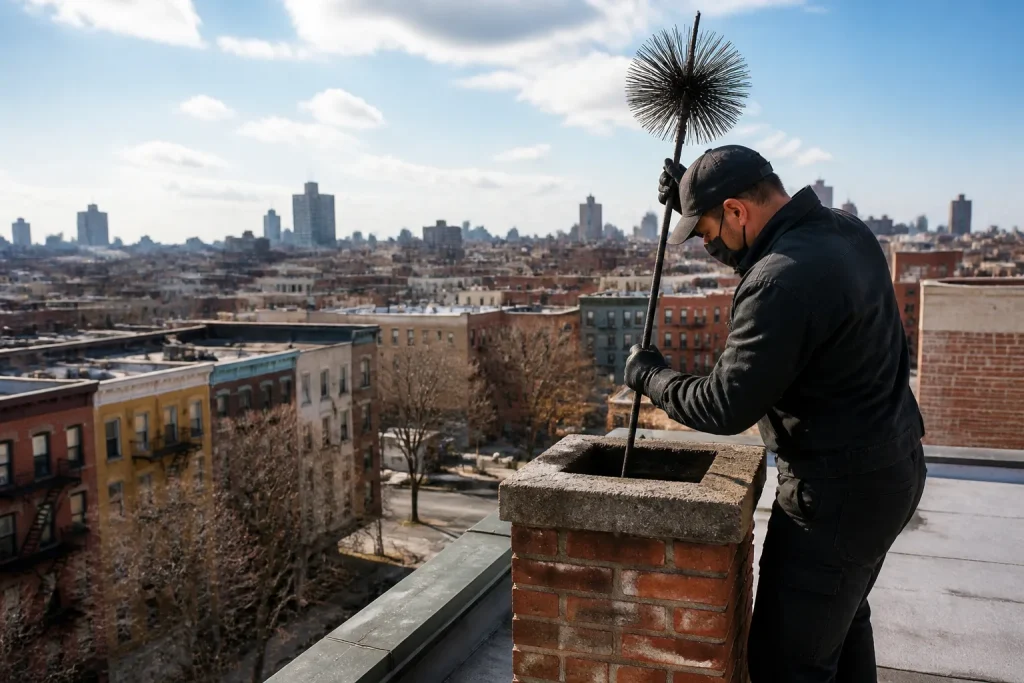
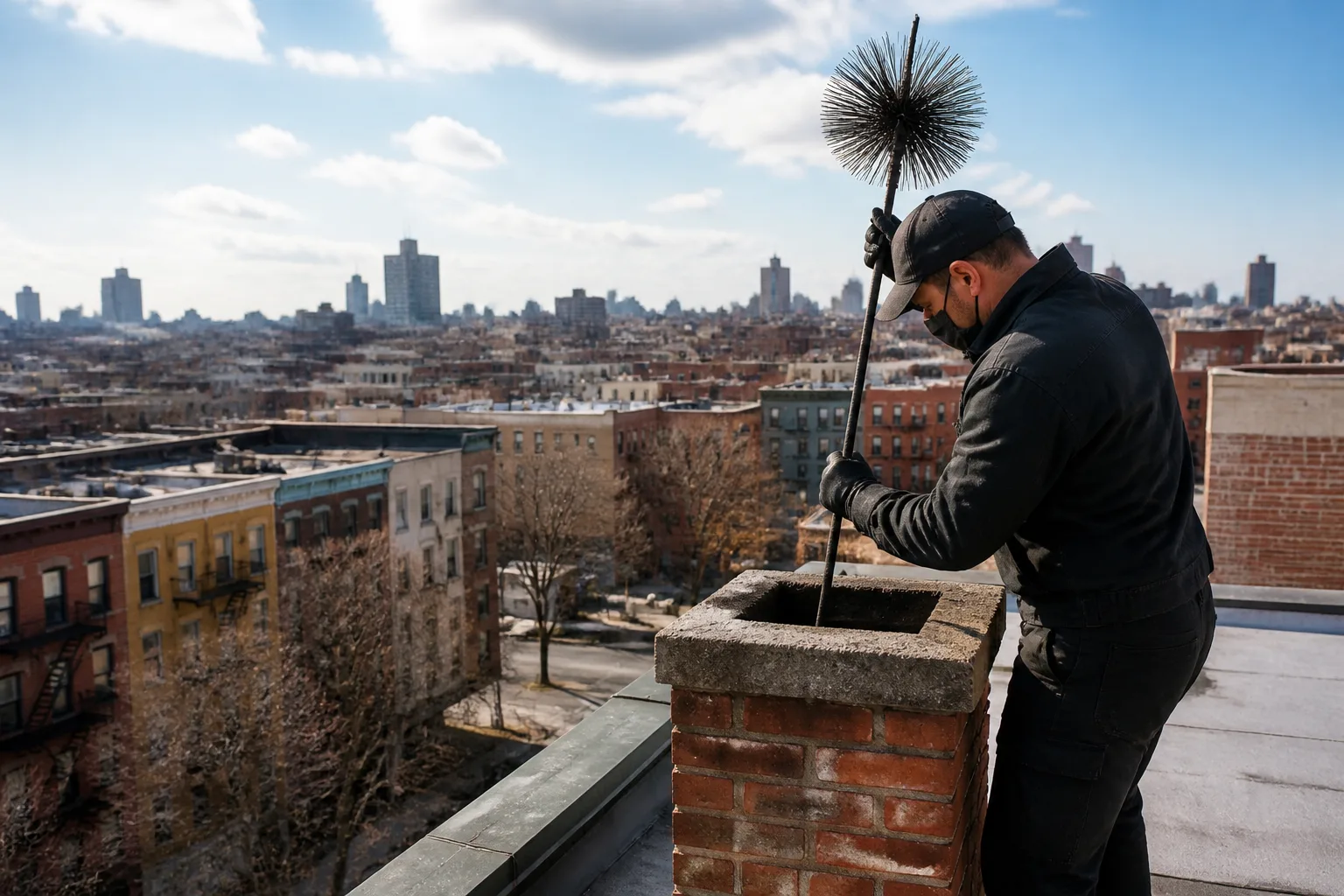
Famco Chimney Sweep in East Harlem: A Homeowner’s Guide
Most chimney problems we get called about in East Harlem don’t start with the firebox. They start at the top. A poorly fitted chimney cap lets rain straight down the flue, and on a windy rooftop it does something worse: it chokes the draft, so smoke and combustion gases have nowhere to go but back into your apartment. Famco makes chimney caps and venting components that professional chimney contractors specify for exactly this reason. If you’d rather not guess at the fit yourself, call (844) 482-6205.
What does Famco actually make, and why do chimney pros specify it?
Famco is a manufacturer of chimney caps, venting components and specialty ventilation products. That’s the whole scope of what we’re talking about here: caps, vent terminations, and the hardware that surrounds them. It is not a liner brand and it is not a masonry product. Knowing where a manufacturer’s expertise actually sits matters, because a lot of chimney advice online confuses one product category with another.
Professional chimney contractors specify Famco caps over the galvanized units stacked in big-box aisles for a few concrete reasons:
- Material gauge and finish. Store-brand caps are typically thin and lightly coated. Famco’s professional line is built heavier, with finishes that hold up through repeated wet-dry cycles rather than rusting through in a couple of seasons.
- Sizing to actual flue dimensions. Generic caps come in a handful of nominal sizes and get forced to fit. Professional caps are matched to the measured outside dimension of the flue tile, which is what determines whether the cap actually seals the top of the chimney.
- Throat and screen design. The open area under the cap and the mesh gauge affect both draft and how quickly the screen clogs with creosote and debris. A cap that clogs easily is a cap that causes draft problems.
In East Harlem, that last point isn’t academic. Rooftops here catch wind off the avenues and across the blocks of six-story walkups with little to break it. A cap that fits loosely rattles, works itself out of position, and eventually lets water past the crown. Our technicians have up to 13 years of experience, and the pattern we see over and over is a cheap cap that failed early and took a section of crown with it.
How does cap design affect draft on East Harlem rooftops?
Draft depends on a steady column of warm air rising up the flue and out the top. Interrupt that at the cap and the whole system backs up. On an exposed East Harlem roof, the wrong cap is one of the most common causes of a fireplace that smokes into the room when the wind picks up. Here’s what goes wrong:
- Undersized throat. A cap with too little open area under the crown restricts flow. It looks fine until the wind shifts.
- Downdraft at the rim. A cap set too close to the flue tile, or one with a flat top and no effective wind band, allows gusts to spill over the edge and push air back down the chimney.
- Loose fit. A cap that isn’t anchored to the flue tile or the crown moves in strong wind. Movement opens gaps, and gaps admit water and disrupt the draft.
- Clogged mesh. Fine mesh catches creosote quickly. Once it loads up, the cap is a plug.
This is the part of the job where the spec really does outweigh the price. A cap chosen for the measured flue dimension and the local wind exposure will do its job for years. A cap chosen because it was on sale is the one you climb up to replace in three seasons. If your fireplace has started smoking on windy days, that’s your signal to look at the top before you suspect anything inside.
What does a proper Famco cap installation look like, and how do you verify it?
East Harlem’s building stock is old, and flue tiles come in a range of outside dimensions depending on when the building went up. Proper installation starts with measuring, not guessing. Here’s what a correct install involves, so you know what to check when the work is done:
- The cap is sized to the measured flue tile, not to a nominal size that’s close enough.
- It’s anchored to the flue tile or crown with fasteners appropriate to the material, not resting loose.
- The fit is snug with no daylight gaps between cap and tile at the base.
- The screen is intact and clean and the mesh gauge suits your fuel type.
- The crown beneath is sound, because a cap seated on a cracked crown still lets water in at the edges.
How to verify: get on the roof, or have whoever does the install photograph the finished cap from a couple of angles. You want to see the seating at the base, the fasteners, and the condition of the crown all in one frame. If the install is bundled with a sweep, ask for the photo report alongside it. We work with Famco caps and Copperfield components, and we photograph what we install so you have a record of it.
How long should a quality chimney cap last in New York’s climate?
New York’s freeze-thaw cycling is the real test. Water gets into seams and joints, freezes overnight, expands, thaws, and repeats through the cold months. Any moisture that finds a weak point works it open a little more each cycle. That’s why a professional-grade cap holds up so much longer than a thin, lightly coated one: the heavier material and better finish resist the water intrusion that drives freeze-thaw damage in the first place.
In practice, the difference shows up in the crown and the flue tile more than the cap itself. A cap that seals properly keeps water out of the structure below it, and that’s where the real money lives. A low-spec cap that fits poorly lets water past the rim, and the damage compounds season after season. In our experience across East Harlem, the caps that fail early almost always fail at the fit or the finish, not from some dramatic event. They simply let water in quietly for a few winters until the crown starts cracking.
This is why we treat the cap as part of the chimney system, not an accessory. It’s the same reasoning that leads us to specify a chimney cap & crown job as a single scope of work. One visit, one set of materials, one install.
When is Famco the right choice, and when is a different cap system better?
A single-flue Famco cap sized to your tile is the right specification for most chimneys in East Harlem. But it isn’t always the right answer, and a contractor who specs the same product on every roof isn’t paying attention. Here’s how we think about it:
- Single flue, standard tile: a properly sized Famco cap is exactly right.
- Two or more flues side by side: a full-coverage multi-flue cap often makes more sense. It covers the whole crown in one unit, protects the masonry between flues, and looks cleaner on a visible roofline.
- Irregular or offset flue: sometimes the flue itself is the problem, not the cap. That’s where a flexible liner from DuraFlex can navigate a shape a rigid liner can’t, and the cap gets spec’d to the new liner’s termination.
- Deteriorating clay tile: if the flue lining is spalling but still structurally sound, HeatShield resurfacing can restore it without a full replacement. The cap decision comes after that.
The point is diagnosis first. We look at the actual configuration, the flue condition, and the roof exposure, then recommend the right fix. A chimney repair that starts with the wrong cap wastes money twice. If the flue needs work, a new cap on a failing flue is a patch, not a repair.
When to call a pro
Measuring a flue tile, seating a cap, and evaluating the crown below it are roof and height work, and the top of a chimney isn’t a place to learn by doing. If your cap is loose, missing, or visibly rusted through, or if your fireplace has started smoking on windy days, it’s time to have it looked at. Our technicians diagnose the problem first, then recommend the right fix, not the most expensive one.
The Bottom Line
Famco makes chimney caps and venting components that are built to tighter tolerances than the generic alternatives, and on East Harlem’s wind-exposed rooftops that difference shows up in how long the cap lasts and how well the chimney drafts. If you have a loose cap, a smoking fireplace, or a cap that’s rusted through, the fix starts with measuring the flue and inspecting the crown beneath it, not with a trip to the hardware store.
We cover the whole chimney: chimney sweep and inspection, cap and crown, and repair, all from one team. One call, and all of it is handled: Chimney Sweep East Harlem covers the full chimney lifecycle, so there’s no second contractor to chase down. Estimates are free and the price is set per job by a written estimate. Call (844) 482-6205. We answer 24/7. Fast dispatch from 7am to 7pm, Sunday through Friday.
Frequently Asked Questions
No. Famco makes chimney caps and venting components. Liners are a separate category, and for those we work with brands like DuraFlex for flexible stainless liner systems and HeatShield for flue resurfacing. Knowing which product does which job is part of getting the diagnosis right the first time.
Yes. A cap that’s undersized, set too close to the flue, or loose in the wind can disrupt draft and allow combustion gases to spill back into the living space. On East Harlem’s windy rooftops this happens more than people expect. If your fireplace smokes when the wind picks up, have the cap checked before you assume the problem is inside.
It should be sized to the measured flue tile, anchored with fasteners, and snug at the base with no gaps. Ask for photos of the finished install showing the cap seated and the crown beneath it. If the cap can be nudged by hand, it isn’t right, and it will move in a strong wind.
That depends on the flue condition, and the only way to know is to look. If the clay tile is sound, a properly sized cap may be all you need. If the tile is deteriorating, resurfacing with HeatShield can often extend its life without a full replacement. We diagnose first and recommend the fix that fits the actual condition. Call (844) 482-6205 for a free estimate.
Written by the team at Chimney Sweep East Harlem.
Need Chimney Cleaning Help?
Call Chimney Sweep East Harlem - the local pro we connect you with is licensed and insured, here with fast help in East Harlem.
(844) 482-6205